
Europe Packing and Phone Checklist
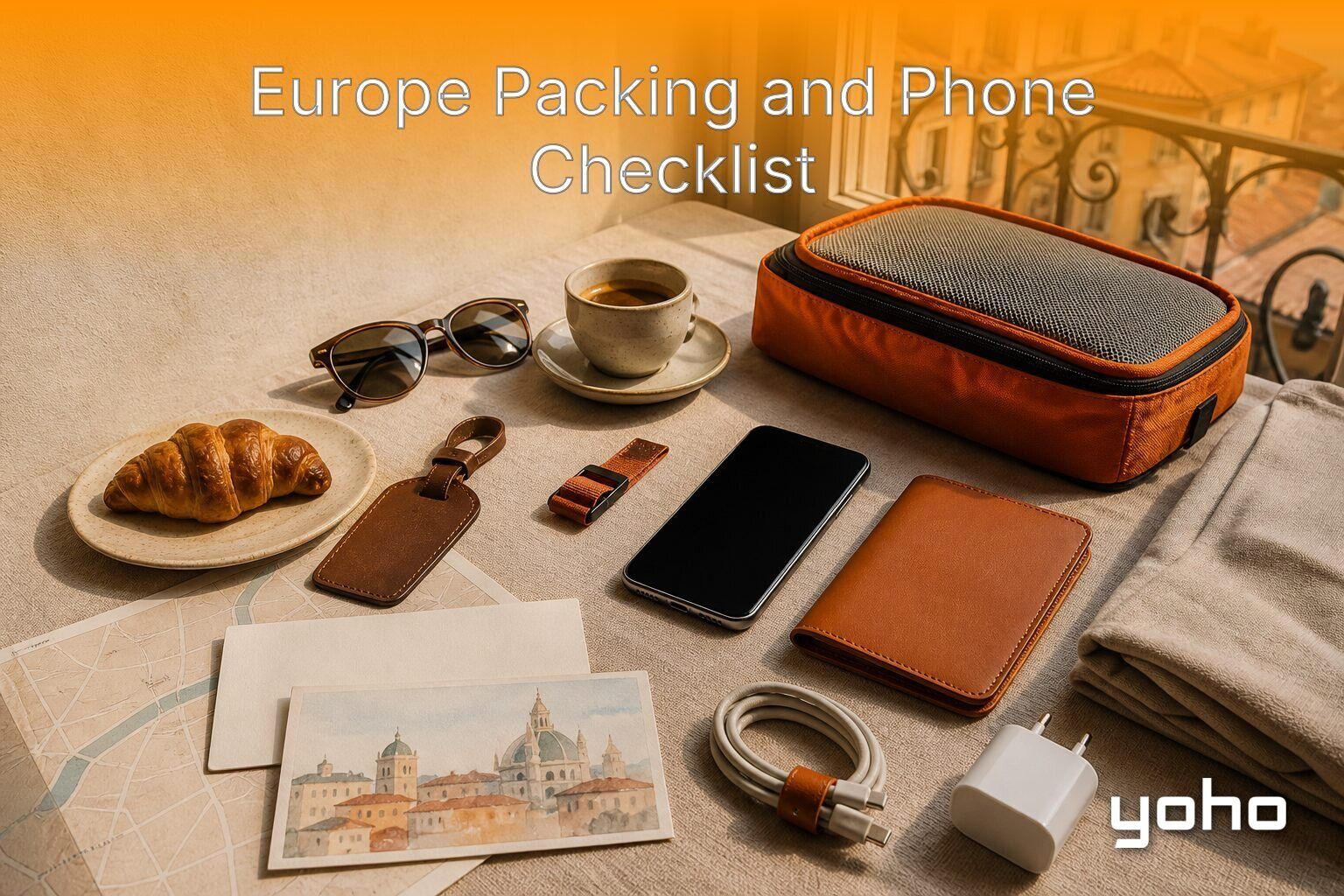
Europe trips can involve budget-airline bag checks, old-city cobblestones, multiple currencies, border-zone documents, and phone settings that need attention before you board. A missing adapter, unverified ticket app, dead battery, or unavailable map can turn a simple train transfer into a paid taxi, a missed museum slot, or a stressful airport queue. This checklist shows you what to pack for Europe, what to leave at home, and how to prepare your phone so your first day runs smoothly.
What Should You Pack First for a Europe Trip?
Your first Europe packing layer should cover survival, movement, and proof: passport, payment cards, prescription medication, phone charger, adapter, one spare outfit, and walking shoes. Put these in your carry-on or personal item so a delayed checked bag does not interrupt your first 24 hours.
A practical Europe packing list starts with the items that are hardest to replace quickly. Clothes can be bought in most city centers. A passport, prescription, card, or charger during a Sunday arrival in a smaller town is a different problem. Pack the essentials first, then add comfort items only if you still have space.
Pack the non-negotiables before outfits
- Passport and entry documents:Keep your passport valid for the full trip and store a photo copy separately from the original. If your route includes the Schengen Area, the United Kingdom, Türkiye, or the Balkans, check each entry rule before travel.
- Two payment methods:Bring one primary card, one backup card, and a small amount of cash. In some smaller cafés, markets, public toilets, and luggage lockers, cash still helps.
- Prescription medication:Pack it in the original labeled container. Bring enough for the trip plus two extra days in case a flight or train changes.
- Phone power setup:Pack one wall charger, one cable, and a power bank under airline battery limits. A 10,000 mAh power bank is enough for most long sightseeing days.
- One clean outfit:Put underwear, socks, and a top in your carry-on even if you check a suitcase.
Pro tip:Use a small pouch for “first-night items”: toothbrush, medication, charger, sleepwear, and the next day’s underwear. If you arrive after 9 p.m., you will not need to unpack your whole bag in a narrow hotel room or shared hostel dorm.
For luggage, check the specific airline rather than trusting a generic size chart. A common cabin-bag size is around 22 x 14 x 9 inches, or 55 x 35 x 23 cm, but European low-cost airlines often sell different tiers for under-seat bags and overhead cabin bags. If you are flying with one small personal item only, pack as if every centimeter will be measured at the gate.
Which Documents and Money Items Matter Most in Europe?
The most important document and money items for Europe are your passport, visa or travel authorization if required, accommodation address, return or onward ticket, travel insurance details, payment cards, and emergency cash. Keep digital and offline copies because Wi-Fi and ticket apps can fail at checkpoints.
Europe travel essentials are not only things you put in a suitcase. You also need proof that lets you board, cross borders, check in, collect rentals, and pay when a card terminal refuses a foreign transaction. Treat your document setup like a small travel wallet system: original documents, offline copies, and emergency backups.
Build a border-ready document folder
- Passport:Carry it in your personal item during travel days. Do not place it in an overhead bag if you may fall asleep on a train or bus.
- Entry permission:Check whether your nationality needs a visa, electronic authorization, or proof of onward travel for each country on your route.
- Hotel and apartment addresses:Save the first night’s address offline. Border officers, taxi drivers, and late check-in staff may ask for it.
- Travel insurance:Keep the policy number and emergency phone number in your notes app and on paper.
- Tickets and bookings:Save PDFs for flights, trains, ferries, museum slots, and airport transfers.
Money planning is simple if you avoid relying on one method. Use a no-foreign-transaction-fee card when possible, but carry €50 to €100 in small notes for arrival transport, food, toilets, tips where appropriate, or a machine outage. If you visit countries outside the eurozone, such as the United Kingdom, Switzerland, Czechia, Hungary, Poland, Denmark, Norway, or Sweden, do not exchange too much cash at once. Card payment is common in many places, and leftover currency is easy to forget.
Pro tip:Store one backup card away from your main wallet, such as inside a zipped pouch in your daypack. If your wallet is lost, you still have a way to pay for transport and accommodation.
Airport security also affects your document and money packing. Liquids usually need to be in containers of 100 ml or less and placed together in a clear 1-litre bag at many European airports, though some airports with newer scanners may vary. For a deeper pre-flight packing routine, use thisairport security packing guidebefore you close your bag.
How Should You Pack Clothes for European Weather and Streets?
Pack clothes for Europe in layers, not bulky outfits: a weather shell, breathable base layers, comfortable walking shoes, and one nicer outfit cover most city trips. Cobblestones, stairs, rain, and temperature swings matter more than fashion variety, especially if your route crosses regions.
What to pack for Europe depends on season, region, and trip style. A May route through Lisbon, Paris, and Amsterdam needs different layers from a December route through Vienna, Prague, and Munich. The common rule is simple: Europe rewards repeatable outfits, walkable shoes, and outerwear that handles rain.
Choose shoes before choosing outfits
- Primary walking shoes:Bring shoes already broken in. Many European city days reach 15,000 to 25,000 steps because old centers, metro stairs, museum routes, and viewpoints add up quickly.
- Second pair:Pack lightweight flats, sandals, or compact sneakers if space allows. Wet shoes need time to dry.
- Avoid fragile soles:Thin soles feel rough on cobblestones in cities such as Rome, Prague, Lisbon, and Edinburgh.
Layer by season, not by country count
| Season | Pack these core clothing items | Watch for this Europe-specific issue |
|---|---|---|
| Spring | Light sweater, rain jacket, jeans or trousers, scarf | Warm afternoons and cold evenings in the same city |
| Summer | Breathable tops, linen or light trousers, sun hat, light layer | Church dress codes, strong sun, and limited air conditioning |
| Autumn | Medium jacket, knit layer, waterproof shoes, umbrella | Rainy travel days and early sunsets in northern Europe |
| Winter | Thermal base layer, warm coat, gloves, beanie, wool socks | Outdoor markets, icy sidewalks, and heated indoor spaces |
Pro tip:Pack one outfit that works for a restaurant, concert, or nicer hotel bar without needing special shoes. Dark trousers, a wrinkle-resistant top, and clean walking shoes often pass in more situations than a separate formal outfit.
Laundry access changes the whole suitcase. If your trip is longer than seven days, pack for one week and plan a wash. Many apartments have a washer but no dryer, so quick-dry socks and underwear are useful. A small laundry sheet, sink stopper, and travel clothesline can save space on multi-city routes.

How Do You Prepare Your Phone, Maps, and Mobile Internet?
Prepare your phone for Europe by checking compatibility, saving offline maps, backing up tickets, packing the right adapter, enabling security features, and arranging mobile data before arrival. A working phone affects navigation, translation, transit, payments, accommodation access, and emergency communication.
Your Europe phone travel guide should be part of packing, not a task for the airport. Many travel problems now pass through your phone: QR train tickets, apartment lock codes, rideshare pickups, restaurant reservations, translation, banking alerts, and two-factor authentication. If your phone is not ready, even a perfectly packed suitcase will not help much.
Check your phone compatibility before buying anything
Pro tip:Check whether your phone is carrier-unlocked at least one week before departure. A locked phone can block travel mobile data options even when the device model itself supports them.
Download offline maps before you board
Offline maps:Save Google Maps areas for your arrival city, hotel neighborhood, airport route, and first train station. Offline maps are not perfect for live transit disruptions, but they help when you land with weak signal, airport Wi-Fi is crowded, or your first task is simply finding the right metro line.
For sightseeing, save pins for your hotel, nearest pharmacy, supermarket, embassy or consulate if relevant, and late-night food near your accommodation. If you rent a car, download maps for rural areas before leaving the city. Mountain roads, islands, and border regions may have weaker coverage than central neighborhoods.
Arrange mobile data before arrival
Europe eSIM travel setup:The GSMA describes eSIM as a global specification for remote SIM provisioning, which is why many modern phones can activate an eSIM profile without inserting a physical SIM, according to theGSMA eSIM overview. For Europe, this means you can prepare mobile data before landing instead of searching for a kiosk while tired.
Other options can also work. Holafly offers unlimited data on many routes, which is useful if you stream heavily or avoid monitoring usage. Airalo and SIM Local can suit travelers who prefer preset travel bundles or airport retail counters. Yoho Mobile fits best when you want to choose the destination countries, mobile data amount, and usage days separately instead of working around fixed plan structures.
If you want a flexible trip-specific option,explore Yoho Mobile eSIM plansand choose the countries, data amount, and duration that match your route.
If you are trying this for the first time, you can read about thefree eSIM trialandYoho Careemergency data service together before your trip, so you know what backup options exist.
Download theYoho Mobile app on iOSorYoho Mobile app on Androidto manage your eSIM plan, check remaining mobile data, and keep your travel setup in one place.
Save tickets where signal does not matter
Ticket backups:Save PDFs to your phone wallet, files app, and email. Take screenshots of QR codes only when the ticket provider allows screenshots, because some rail and event tickets refresh dynamically. Keep your passport name consistent with ticket bookings, especially for international trains, ferries, and flights.
Security setup:Turn on screen lock, device tracking, and cloud backup before departure. Use a password manager for banking and booking apps. If you rely on SMS codes, check whether your home number can receive messages abroad or move key accounts to app-based authentication before you travel.
Network quality differs by country and city, so do not assume one experience covers all of Europe. Ookla publishes country-level mobile performance benchmarks in theSpeedtest Global Index, which can help set expectations for video calls, uploads, and remote work days.
For a deeper compatibility check before departure, readhow to know whether your phone will work in Europe. It is especially useful if you are bringing an older Android phone, a carrier-locked device, or a secondary travel phone.
What Should You Not Pack for Europe?
Do not pack bulky “just in case” items for Europe: extra shoes, full-size toiletries, heavy hair tools, too many jeans, expensive jewelry, and items banned in carry-ons. Most forgotten basics are easy to buy, while overpacking makes stairs, trains, and small hotel rooms harder.
Europe packing mistakes usually come from planning for every possible scenario instead of the likely travel day. Many hotels have compact rooms, older buildings may not have elevators, and train platforms can involve stairs. A lighter bag gives you more control during transfers, late arrivals, and crowded public transport.
Leave bulky toiletries at home
- Full-size shampoo and conditioner:Buy locally or use solid bars. Carry-on liquids over 100 ml can be removed at security in many airports.
- Large perfume bottles:Pack a small atomizer instead. Glass bottles add weight and can leak.
- Big skincare routines:Decant only what you use daily. A 10-day trip does not need a bathroom shelf of products.
Skip clothing that solves only one situation
- New shoes:Blisters can ruin museum days and train transfers. Bring tested footwear.
- Too many jeans:Denim is heavy and slow to dry. One pair is usually enough for a short trip.
- Formal wear without a specific booking:Unless you have an event, pack one smart-casual outfit instead.
- Heavy coats in shoulder season:Use layers unless the forecast clearly calls for winter gear.
Pro tip:If an item is easy to buy for under US$15 and you are packing it only because you feel anxious, leave it out. Use that space for the things that are hard to replace: medication, documents, chargers, and comfortable shoes.
Be careful with high-value items. Europe is not unusually unsafe for travelers, but crowded tourist zones, night trains, and busy metro lines reward simple habits. Leave expensive jewelry at home unless you need it for a specific occasion. Use a crossbody bag with a zipper, keep your phone out of back pockets, and avoid placing a daypack on the back of a café chair.
Do not pack large “travel gadgets” unless they solve a real problem. A compact adapter, a power bank, and noise-reducing earbuds earn their space. A full laptop stand, bulky steamer, or large camera kit may be worth it for remote work or photography trips, but not for every traveler. If your route has many train changes, each extra pound becomes noticeable.
When Should You Do the Final Europe Packing Check?
Do your final Europe packing check 48 hours before departure, then a smaller phone-and-document check the morning you leave. This timing gives you enough room to buy missing items, print backups, charge devices, and fix app or payment problems before airport pressure starts.
The best final check is not a rushed suitcase scan at midnight. Treat it like a short travel rehearsal: can you prove who you are, pay, navigate, contact people, charge your devices, and handle the first day if your checked bag is delayed? If yes, you are ready.
Run the 48-hour checklist
- Documents:Passport, visa or authorization if needed, insurance, booking confirmations, first-night address, transport tickets.
- Money:Primary card, backup card, small cash, banking app login, travel notices if your bank uses them.
- Clothes:Walking shoes, weather layer, one nicer outfit, sleepwear, underwear, socks, laundry plan for longer trips.
- Toiletries:100 ml carry-on liquids, medication in original packaging, spare contact lenses, glasses, sunscreen where needed.
- Tech:Phone, charger, cable, adapter, power bank, offline maps, tickets saved offline, mobile data arrangement.
- Daypack:Water bottle, tissues, hand sanitizer, sunglasses, compact umbrella, small lock if staying in hostels.
Do the morning-of-departure check
- Charge everything:Phone, earbuds, power bank, laptop or tablet if packed.
- Open key apps once:Airline, train, accommodation, maps, banking, translation, and password manager.
- Check airport timing:Arrive about 2.5 to 3 hours before long-haul international flights and earlier if you need baggage drop, document checks, or tax-refund processing.
- Weigh your bag:Home luggage scales are small, and they prevent repacking on the airport floor.
Pro tip:Put your passport, phone, wallet, charger, and medication in the same personal item pocket every time you move. Repetition prevents most “where did I put it?” moments during airport security, train boarding, and hotel check-in.
Your final Europe travel essentials check should feel boring. That is the point. If your documents are accessible, your phone works, your shoes are comfortable, and your bag is light enough to lift onto a train rack, you have solved the biggest practical problems before they start.
Frequently Asked Questions
What if my carry-on is slightly over the size limit?
Move dense items into your personal item before you reach the gate and wear your bulkiest layer. Low-cost European airlines often check bag dimensions more strictly at boarding than at check-in. If your fare includes only an under-seat bag, measure the packed bag at home, not the empty bag.
What if my phone is not compatible with eSIM?
Use a physical SIM, portable hotspot, or your home carrier option, and confirm bands before departure. You can still prepare offline maps, saved tickets, translation files, and Wi-Fi calling where supported. Device limitations are normal, especially with older or carrier-locked phones.
What if I visit both Schengen and non-Schengen countries?
Pack documents as if every border can ask for proof: passport, onward ticket, accommodation address, insurance, and payment card. Keep these in your personal item, not checked luggage. Train and bus borders can feel casual, but you still need access to the same documents.
What if I forget a charger or adapter?
Buy a replacement at an airport electronics shop, train station, pharmacy, or supermarket, but expect higher prices at airports. A compact USB-C charger is usually easier to replace than a country-specific brick. If you arrive late, ask your accommodation desk before searching shops.