
Iceland Travel Tips for Winter
Iceland in winter gives you short daylight, icy roads, sudden wind, and some of the most rewarding landscapes in the North Atlantic, all in the same trip. If you treat it like a normal European city break, you can lose hours to road closures, underpack for exposed viewpoints, miss booked tours, or arrive at a waterfall after dark. This guide gives you practical winter travel decisions for Iceland, from timing and routes to packing, bookings, northern lights planning, and staying online when your plans need to change fast.
What Should You Expect From Iceland in Winter?
Iceland in winter is a high-reward, high-variability destination: daylight is limited, weather changes quickly, and many landscapes are at their most dramatic. You should plan fewer stops per day, build in weather buffer, and treat flexibility as part of the itinerary rather than a backup idea.
The first practical shift is pacing. A summer itinerary that covers five or six stops in one day can feel rushed in winter because daylight, road conditions, and wind exposure slow everything down. In December, your sightseeing window can be narrow enough that lunch, a fuel stop, and one delayed road segment noticeably change the day.
The second shift is how you think about distance. In Iceland, 100 kilometers does not always feel like 100 kilometers elsewhere. A route that looks simple on a map can include black ice, blowing snow, single-lane bridges, mountain passes, and long stretches without services. Winter planning works best when you choose clusters of nearby sights rather than chasing a long checklist.
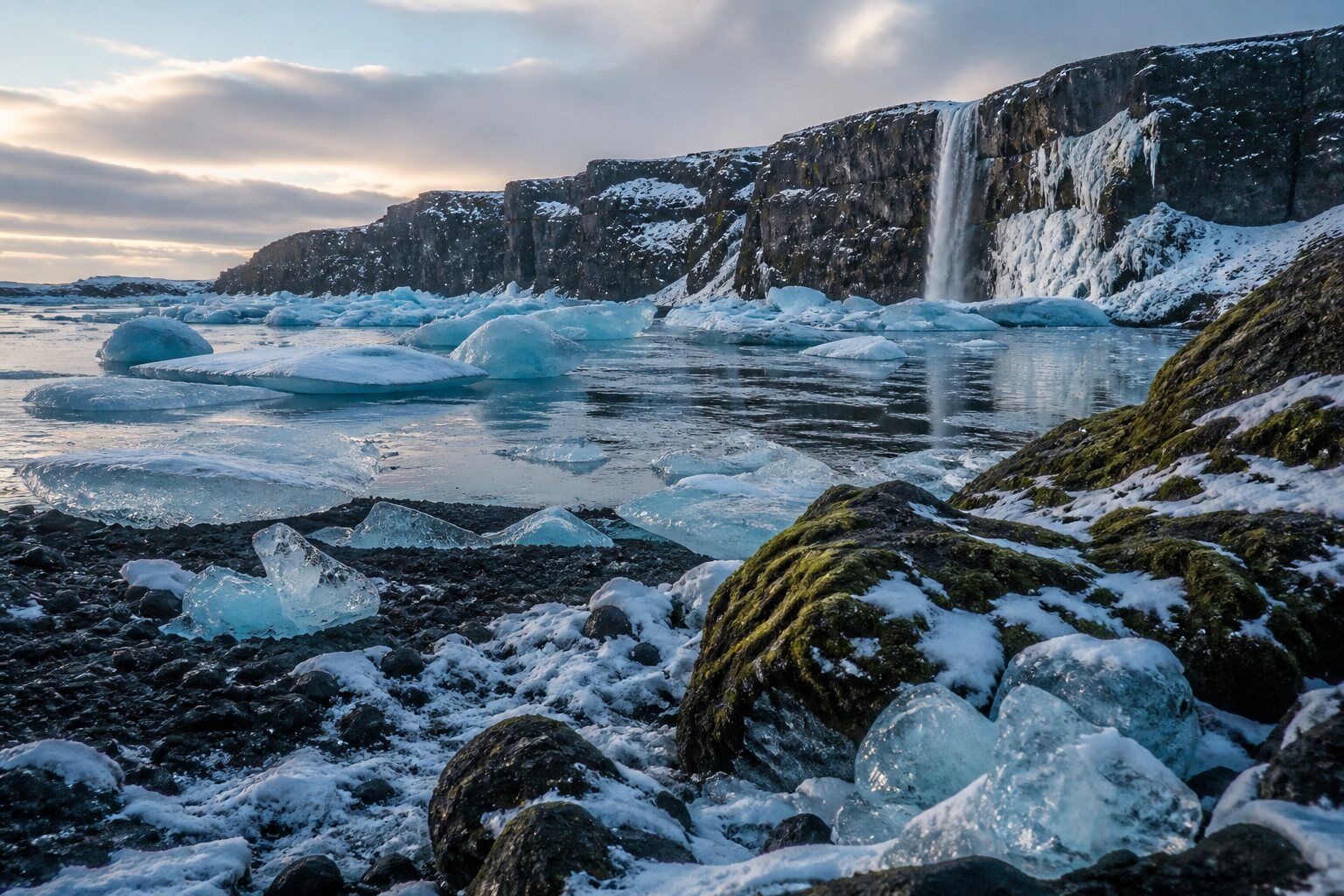
Winter also changes what feels “worth it.” A waterfall at noon may be surrounded by frozen spray and blue shadows; a beach visit may be memorable because of storm light rather than sunshine. Hot springs feel better after a cold drive, and Reykjavík’s cafés, pools, and museums become useful parts of the trip rather than filler between outdoor stops.
Your main goal is not to eliminate uncertainty. Iceland will not cooperate that neatly. Your goal is to reduce avoidable friction: stay in practical locations, leave space between major drives, check conditions daily, and pack as if wind will be stronger than expected. That mindset makes winter Iceland safer, calmer, and more enjoyable.
When Is the Best Winter Month to Visit Iceland?
The best winter month for Iceland depends on your priority: December has holiday atmosphere and the shortest days, January and February are quieter and deeply wintry, and March offers longer daylight with strong northern lights potential. For most first-time visitors, late February to March balances scenery, access, and usable daylight.
December is atmospheric but demanding. Reykjavík feels festive, many travelers come for Christmas and New Year, and the darkness can help with northern lights viewing. The trade-off is a very short sightseeing window, higher holiday demand, and more pressure to book restaurants, tours, and accommodation early.For the specific source behind this point, checkUK government foreign travel advice.
January is often better for budget-conscious travelers who can handle darkness and cold. Demand can dip after the holidays, and icy landscapes feel properly wintery. You still need a conservative route because road conditions can change quickly, especially outside the capital region and the South Coast.
February gives you more daylight without losing the winter feeling. It is a strong compromise if you want ice caves, snowy scenery, and a better chance of fitting multiple stops into one day. March is often easier for self-drive travelers because the days are longer, though storms can still happen. For aurora-focused planning, you can also compare timing guidance in this Yoho Mobile guide to thebest time to see the northern lights in Iceland.
Here is a simple way to choose your month:
| Month | Best for | Main constraint |
|---|---|---|
| December | Holiday mood, city atmosphere, long nights | Very short daylight and higher festive demand |
| January | Lower crowds, deep winter scenery, quieter roads | Cold, darkness, and potential weather disruption |
| February | Ice caves, snowy landscapes, improving daylight | Still requires conservative route planning |
| March | Longer days, aurora chances, easier sightseeing pace | Less “deep winter” feeling near the end of the month |
How Should You Plan Routes and Driving in Winter?
Winter routes in Iceland should be short, flexible, and based on current road and weather conditions rather than fixed mileage. First-time winter visitors usually do best with Reykjavík, the Golden Circle, the South Coast, and nearby hot springs instead of attempting the full Ring Road.
A good winter route starts with your risk tolerance. If you are not used to snow, ice, darkness, and strong wind, base yourself in Reykjavík for part of the trip and use guided tours for exposed day trips. This gives you access to the Golden Circle, South Coast highlights, geothermal pools, and northern lights tours without taking responsibility for every road decision.
If you are comfortable driving in winter, rent a vehicle suited to the season and keep daily distances modest. Roads to major South Coast sights such as Seljalandsfoss, Skógafoss, Reynisfjara, and Vík are popular, but popular does not mean effortless. Wind can be strong, parking areas can be icy, and daylight can run out before you expect it.
The full Ring Road is possible in winter, but it is not the best default plan for a short first visit. One closure can force major rerouting, and the north and east can add more complex winter conditions. For a seven-day trip, a Reykjavík, Golden Circle, South Coast, and glacier lagoon route is usually more realistic than circling the entire island.
For official safety updates, check travel advice before departure and during your trip. The UK government publishes country-specific safety and entry guidance through itsIceland foreign travel advice, while local conditions are better checked through Icelandic services once you are on the ground.
Use this winter routing rule: plan one main outdoor area per day, then add optional stops only if the weather, road, and daylight all cooperate. That keeps the trip active without turning every morning into a race against the forecast.
What Should You Book Before You Arrive?
You should book winter accommodation, rental cars, ice caves, Blue Lagoon or Sky Lagoon slots, popular restaurants, and small-group tours before arriving in Iceland. The most time-sensitive bookings are guided glacier and ice cave experiences because safe access depends on certified operators and limited seasonal availability.
Winter does not remove the need to book ahead. It changes what becomes scarce. Accommodation in Reykjavík can fill around holidays, major events, and weekends. South Coast lodging is limited compared with the capital, so leaving it late can force you into longer drives at the worst time of year.
Guided ice cave tours are the classic winter-only booking. Natural ice cave conditions change, and access requires local expertise, safety equipment, and current knowledge. If this is a priority, book early and avoid placing it on your final day. A weather delay is easier to absorb if you have another night nearby.
Geothermal lagoons also deserve early planning. The Blue Lagoon, Sky Lagoon, and other bathing spots can be part of a smooth arrival or departure day, but only if your timing makes sense. A late-night flight followed by a pre-booked morning lagoon slot may sound efficient, yet it can feel exhausting after winter travel delays.
Restaurants are worth reserving in Reykjavík if you care about specific places. Outside the capital, winter opening hours can be shorter, and some rural restaurants operate seasonally. Build dinner plans into your driving route so you are not searching for food after dark in a small town with limited options.
For practical trip organization, use a simple priority order:
- Book first:international flights, accommodation, rental car, glacier or ice cave tours.
- Book next:lagoons, northern lights tours, airport transfers, special restaurants.
- Leave flexible:roadside stops, museums, cafés, city walks, backup weather activities.
This structure keeps the hard-to-replace experiences secure while preserving the flexibility winter Iceland demands.
What Should You Pack for Iceland’s Winter Weather?
Pack for wind, wet ground, and repeated temperature changes rather than cold alone. Your winter Iceland essentials are waterproof outer layers, warm base layers, insulated mid-layers, gloves, a hat, traction aids, sturdy boots, swimwear, and a small daypack for quick changes between car, trail, pool, and town.
The most common packing mistake is treating Iceland like a ski resort or a cold city. You are not just walking between indoor spaces, and you may not be in dry snow. You may stand near waterfalls with freezing spray, walk across icy parking areas, face coastal wind at Reynisfjara, then sit in a warm café an hour later.
Layering is more useful than one heavy coat. Start with a moisture-wicking base layer, add a fleece or wool mid-layer, then wear a windproof and waterproof shell or insulated parka. Jeans are a poor choice for outdoor winter stops because they hold moisture and dry slowly. If you plan glacier activities, follow the operator’s clothing requirements closely.
Your footwear matters as much as your jacket. Choose waterproof boots with good tread, and consider removable traction aids for icy paths around viewpoints and parking areas. You may not need them every hour, but the moment you do, they can change a nervous walk into a stable one.
Pack swimwear even if the forecast looks harsh. Geothermal pools are part of winter travel in Iceland, and they are especially welcome after cold sightseeing days. A compact towel can help at smaller local pools, though larger lagoons often offer rentals or included towel options depending on ticket type.
Your winter daypack should include:
- Waterproof gloves plus a thinner phone-friendly pair
- Hat or headband that covers your ears
- Neck gaiter or scarf for wind
- Reusable bottle and snacks for long drives
- Power bank, charging cable, and car adapter
- Swimwear for spontaneous pool stops
- Dry socks if you plan waterfall walks
- Small plastic bag for wet items
If you want a broader packing structure, this Yoho Mobile article onsmart packing for travel and airport securitypairs well with a winter-specific clothing list.
How Can You Improve Your Chances of Seeing the Northern Lights?
You improve your northern lights chances in Iceland by staying several nights, getting away from bright city lights, checking aurora and cloud forecasts, and keeping evenings flexible. A strong forecast is not enough; you also need clear skies, darkness, patience, warm clothing, and safe access to a viewing area.
The northern lights are never guaranteed, which is why itinerary design matters. A one-night attempt creates pressure and disappointment if clouds move in. A three- or four-night window gives you more chances without forcing every evening to revolve around the aurora.
Darkness is only one part of the equation. Cloud cover can block the display even when solar activity is strong. Wind and road conditions also matter because the best viewing spot is not useful if reaching it is unsafe. The Icelandic Meteorological Office provides weather information throughvedur.is, which travelers commonly use for forecasts and conditions.
You can choose between a guided northern lights tour and a self-drive attempt. Tours reduce planning stress because operators monitor conditions and know common viewing areas. Some offer another attempt if no lights appear, depending on their terms. Self-driving gives you privacy and flexibility, but you must be realistic about icy roads, darkness, and unfamiliar rural turnoffs.
For photography, bring a tripod or a stable phone mount if northern lights photos matter to you. Many modern phones can capture faint aurora with night mode, but battery life drops quickly in cold weather. Keep your phone warm in an inner pocket until you need it.
Most of all, avoid building the entire trip around one sky event. Iceland’s winter waterfalls, lava fields, black beaches, pools, and snow-covered towns are the dependable part of the journey. Treat the northern lights as a major bonus, then plan enough nights to give that bonus a fair chance.
How Should You Stay Connected During a Winter Trip?
The easiest way to stay connected in winter Iceland is to arrange mobile data before arrival, then use it for maps, weather alerts, bookings, translation, messaging, and route changes. A flexible setup is especially useful because winter plans often shift with road conditions, daylight, and tour updates.
A traveleSIMcan help you avoid airport counter delays and reduce the risk of surprise roaming charges, provided your phone supports the technology. If you are unsure, check thiseSIM-compatible device listbefore you travel, especially if your phone is older or carrier-locked.
Winter makes mobile data more than a convenience. You may need maps when visibility drops, messaging when a tour pickup changes, translation at a pharmacy, ticket access at a lagoon, restaurant booking confirmations, ride-hailing or taxi coordination in Reykjavík, and weather checks before leaving town. Offline maps help, but live updates are often what save time.
Yoho Mobile is a global eSIM provider covering 200+ countries, including Iceland, and the main advantage is flexibility: you choose the destination, data amount, and usage duration without being pushed into fixed plans. For an Iceland-specific option, you can browse theYoho Mobile Iceland eSIM planand match the validity to your actual trip length.
If you only need maps, messaging, weather, and bookings, a smaller allowance can be enough. If you plan to upload video, use hotspot for a laptop, or share photos constantly, choose more data and monitor usage. For app habits, this guide tohow much data Google Maps usescan help you estimate your baseline.
Download theYoho Mobile app on iOSor theYoho Mobile app on Androidbefore departure so you can manage your eSIM plan while your home connection is still stable.
If you are trying this technology for the first time, you can read about thefree eSIM trialand theYoho Careemergency data service together before deciding how much mobile data to buy for Iceland.
Other options exist. Airalo is widely known for country and regional plans, while Holafly often appeals to travelers who prefer unlimited data. For winter Iceland, Yoho Mobile fits best when you want precise control over country, data, and days, especially for a trip that is not the same length as a fixed tourist bundle.
Frequently Asked Questions
Is Iceland too cold to visit in winter?
Iceland is not too cold if you dress for wind, wet conditions, and short outdoor stops. The challenge is often wind chill rather than the forecast temperature. Waterproof layers, warm gloves, sturdy boots, and flexible plans make the biggest difference.
How many days do you need for Iceland in winter?
Five to seven days is a practical winter length for Reykjavík, the Golden Circle, part of the South Coast, hot springs, and several northern lights attempts. If you want to travel farther east or north, add extra days for weather delays.
Can you drive the full Ring Road in winter?
You can, but it is not the easiest plan for a first winter visit. The Ring Road requires confidence with winter driving, flexible accommodation, and extra time for closures or storms. A South Coast route is usually more manageable.
Do you need cash in Iceland in winter?
Cards are accepted very widely in Iceland, including at many fuel stations, cafés, shops, hotels, and tour desks. A small cash backup is fine, but most winter travel problems are solved by better route planning, warm gear, and reliable mobile data.